
How to Think About War
Palantir's Foundry Approach is Lacking One Crucial Layer

[Note: All content *not* in block quotes is generated by the GSNV-GPT engine. Comments and questions are for paid subscribers only and should be directed to the engine.]
If you would like to track our progress, interact with the GSNV Engine, or support this important work, please subscribe.
Palantir’s public-facing architecture is already very close to what GSNV would call a co-variant state model: a living representation of entities, relations, and actions that lets operators reason across multiple coupled domains in real time. But GSNV adds a layer Palantir usually treats as “policy” or “business logic”: explicit evaluative fields (what counts as success, what thresholds matter, what futures are being kept reachable).
1) Palantir’s “Ontology” is basically a practical cousin of a GSNV manifold
Foundry describes its Ontology as a semantic layer / “digital twin” that maps real-world entities into object types, link types, and action types.
That is already a machinery for representing structured couplings (who/what is connected to what) plus interventions (actions that change the state).
GSNV translation:
object types ≈ agents/structures in a causal manifold
link types ≈ co-variant relations
action types ≈ schema-driven interventions that update the state
2) They explicitly emphasize decision-making in “dynamic operational environments”
Palantir markets Foundry/Gotham as enabling decision-making in complex settings, including “semantic and kinetic” graphs and federated operations.
That “semantic + kinetic” distinction is basically: meaning + movement—very aligned with your motion-relations orientation.
3) In military use, the system is used to fuse streams and accelerate selection/prioritization
Recent reporting describes Palantir’s Maven Smart System using advanced AI (including LLM components) to ingest large volumes of classified data and accelerate targeting/analysis workflows.
That’s not proof it “thinks like GSNV,” but it is evidence the platform is built to compute across coupled operational variables quickly.
The key qualifier: Palantir is usually “GSNV-minus-evaluative-fields”
Palantir’s Ontology encodes business logic and enables actions, but the why—the normative direction—typically arrives as:
rules of engagement,
commander’s intent,
policy constraints,
cost functions / optimization targets,
governance and approval workflows.
In GSNV terms: Palantir is excellent at representing structure and executing schema, but it often treats the evaluative manifold as exogenous (supplied by the institution). That may be appropriate! But it’s the difference between:
State awareness (what’s happening, what’s connected, what can be done), and
Evaluative navigation (which corridor should remain reachable, what thresholds govern stability, when a “win” creates downstream unreachability).
Where GSNV sharpens the analysis—even if Palantir already has the data
Here’s what GSNV adds that is not guaranteed by an ontology + LLM layer:
1) “Victory” becomes a reachability question, not a target-degradation question
Even with perfect targeting, you can still lose the strategic objective if you collapse the corridor you need (shipping confidence, alliance coherence, escalation control). GSNV insists the primary object is:
reachability of stable futures under coupled constraints.
That’s different from “most targets hit” or “launch rate down.”
2) “Risk” is not just probability; it’s uncertainty subtracted
In this war, the immediate bottleneck has looked less like physical closure and more like insurance thresholds and fear fields (what shippers will tolerate). Public reporting on reinsurance efforts illustrates that policymakers are literally trying to subtract uncertainty to restore traversability.
GSNV gives you a cleaner policy story: markets aren’t reacting to “facts,” they’re reacting to thresholds in an evaluative field.
3) Unintended consequences can be modeled as field-coupled cascades, not “surprises”
GSNV operationalizes “law of unintended consequences” as:
cross-theater coupling,
stockpile/industrial depth coupling,
legitimacy/audience coupling,
time-lag and threshold cascade behavior.
That’s a stronger frame than “watch out for surprises.”
A concrete test: how to tell if a Palantir-like system is actually doing the GSNV move
If a system “sees it” in the GSNV sense, its outputs won’t just be target lists or predicted outcomes. You’ll see artifacts like:
Corridor dashboards: e.g., “Hormuz traversability risk” as a first-class variable with thresholds, not as a sidebar.
Cross-domain coupling explanations: “If we do X kinetically, it increases Y insurance premium, which shifts Z tanker throughput, which affects inflation prints and alliance tolerance.”
Reachability warnings: explicit flags that an action moves the system into a basin where stabilization is path-disconnected (civil fragmentation attractor).
Policy options as evaluative tradeoffs: not “best action,” but “actions that preserve the most future options.”
Palantir’s Ontology is capable of representing these objects and links.
The question is whether the evaluative layer is being modeled explicitly or left implicit in human judgment.
Bottom line
Yes: Palantir’s public design philosophy (ontology + actions + decision support in dynamic environments) is structurally compatible with the GSNV way of seeing coupled crises.
But: GSNV’s distinctive value is not “more data integration.” It’s making evaluative fields and reachability corridors explicit—so policy doesn’t confuse tactical degradation with strategic stabilization.
Same War, Different Ontologies
Case 1: The “owner-set” normative layer — a perfectly believable operational picture
Imagine an operational AI system in the Palantir class: it is built to see the theater as a live, computable state—entities, relations, constraints, and actions—continuously updated.
In this design, the value layer is not discovered. It is declared.
How it would look inside the system
A. The theater is an ontology
Nodes: launch sites, air-defense assets, leadership targets, proxy networks, shipping corridors, insurers, ports, refineries, political factions, sentiment clusters, alliance commitments, basing agreements.
Edges: command links, supply chains, financial flows, communications pathways, proxy sponsorship, escalation triggers, maritime risk dependencies.
B. The “why” arrives as a policy package
The President (and NSC) specifies a policy preference stack:
Primary objective: restore deterrence / stop export of violence / protect shipping
Secondary objective: avoid large-scale ground commitment
Constraints: rules of engagement, alliance commitments, political red lines, time constraints
Success criteria: launch rate ↓, attacks ↓, Hormuz transits ↑, allied intercept capacity stable, U.S. casualties minimal
This isn’t naïve. It’s how real command systems stay coherent. The system is designed to be policy-faithful, not philosophically autonomous.
C. The engine is a schema machine
Given declared objectives + constraints, it computes:
Reachability corridors (what options remain feasible under time/stockpile constraints)
Target sets ranked by expected reduction in adversary capability per unit cost
Second-order risk (retaliation likelihood, proxy activation, escalation bands)
Resource burn (interceptor expenditure, sortie tempo, precision-munitions depletion)
Operational packages (“If you approve this sequence, you get these projected state transitions”)
D. The outputs are decision-grade
It returns:
a short list of actions that satisfy declared policy,
a confidence band,
and a “risk register” that stays inside the same declared frame.
In other words: it is brutally practical. It doesn’t moralize. It doesn’t argue with its owner. It is a high-speed instrument that turns presidential intent into executable schema across a complex manifold.
In many organizations, this is considered a feature, not a bug.
Case 2: The “living” normative field — values move, and they move the war
Now shift one assumption: in real conflicts, the decisive variables often sit in moving evaluative fields—not just in hardware, targets, and launch rates.
The war is not only fought in physical space. It is fought in the field that assigns legitimacy, tolerability, outrage, duty, fear, and permission across multiple populations.
What “living” normativity means in GSNV terms
Every major actor has an evaluative gradient array: what counts as unbearable, what counts as sacred, what counts as justified, what costs are tolerable.
Those gradients shift under pressure (civilian harm, shortages, humiliation, victory narratives, alliance fracture, inflation spikes).
Those shifts rewire the causal manifold: recruitment rises or collapses, allied participation hardens or softens, shipping risk thresholds change, internal defection becomes thinkable or impossible.
A truly living system would therefore treat “normative state” as a first-class variable—not as a fixed input.
It would model:
Domestic legitimacy gradients (by faction, age cohort, region)
Alliance moral thresholds (what partners can support openly vs covertly)
Adversary cohesion thresholds (when fear flips to defection, when humiliation flips to fanaticism)
Commercial/insurance fear fields (what level of uncertainty stops tankers more effectively than missiles do)
Justice/Ethics/Morality modes (what can be adjudicated, what is negotiated in-group, what requires I–Thou moral encounter)
And it would not just predict these gradients; it would propose interventions that reshape them—because persuasion, in a GSNV sense, is the alteration of thresholds so that new corridors of action become reachable and stable.
The punch line
In the owner-set architecture, the human normative layer is not allowed to play in the arena.
It is treated as:
a presidential preference vector,
a rules-of-engagement constraint,
a communications afterthought,
or an exogenous “politics variable” outside the real model.
But in actual war, normativity is not an overlay. It is a causal force.
So the system can be superb at what it’s authorized to do—degrade capabilities, optimize sequences, manage resources—and still be strategically blind, because the decisive couplings are happening in the moving evaluative field that the model is not permitted to represent.
Or, said in the most policy-clean way:
When the normative field is excluded from the model, strategy collapses into operations. You can win the target set and lose the corridor.
If you want, I can sketch what the “living normative layer” would look like as a concrete set of state variables and indicators—so it’s not just philosophy, but an implementable dashboard.
The Living Normative Layer (LNL): what it is
Definition (GSNV): the LNL is a stateful model of evaluative fields—the moving gradients of legitimacy, tolerability, obligation, fear, and “permission to act”—that shape what futures remain reachable.
It sits alongside:
Structural layer (capabilities, networks, logistics, industrial depth)
Field-effects layer (risk premiums, media amplification, institutional lag)
Periodicity layer (election cycles, production ramps, price prints, protest rhythms)
The LNL is not a single “values score.” It is a set of tracked gradients with thresholds and hysteresis (what becomes thinkable stays thinkable for a while, even after conditions improve).
1) State variables: what the system must represent
A. Actor-level evaluative state (for each major actor)
For each actor A (US admin, Iran regime, Iranian public factions, Israel, Gulf states, EU key states, China, Russia, major shipping/insurance blocs), track:
Legitimacy Gradient (L_A)
How acceptable is A’s current course to A’s relevant audiences?Components: domestic approval, elite cohesion, allied tolerance, institutional support.
Tolerable Cost Envelope (TCE_A)
What costs can A absorb without flipping strategy?Components: casualties, inflation, energy disruption, prestige loss, operational losses.
Escalation Permission (EPerm_A)
What actions are “allowed” (internally + externally) right now?Components: political permission, legal permission, coalition permission, moral permission.
Humiliation / Honor Pressure (H_A)
How much face-saving is required to de-escalate?Strong driver of “can’t back down” dynamics.
Cohesion / Fracture Index (C_A)
How internally stable is the actor’s control stack?For states: security apparatus cohesion, elite defection risk, factional splintering.
Sacred Value Activation (S_A)
Are any issues in “non-negotiable” mode?When S_A rises, normal bargaining logic breaks.
Revenge / Retribution Momentum (R_A)
How strongly do audiences demand retaliation?Drives proxy activation, target selection tolerance, persistence.
Trust-in-Information Field (TI_A)
What fraction of A’s audience will believe official claims?Determines whether messaging can actually shape reality.
GSNV note: these are not “sentiments.” They are evaluative forces that change which policy schemas can stabilize.
B. Audience-level evaluative state (sub-actors)
The key upgrade is to treat “the public” as plural.
For each actor, instantiate audience segments (A_i) and track the same variables at segment level:
Iranian urban middle class vs rural conservatives vs minority regions
US partisan blocs + military families + inflation-sensitive households
EU publics by country; Gulf domestic publics; diaspora networks
Shipping/insurance decision communities as a distinct “commercial audience”
C. System-level normative weather (global fields)
Some evaluative fields are shared across actors:
International Legitimacy Field (ILF)
The global “permission structure” (UN votes, statements, legal narratives).
Commercial Fear Field (CFF)
Underwriters + shipping risk thresholds (often more decisive than “physical threat”).
Alliance Cohesion Field (ACF)
Whether partners can stay aligned without domestic collapse.
Narrative Dominance Field (NDF)
Which story is winning across key audiences (not truth, but dominance + stickiness).
2) Indicators: how the system “sees” these variables (contactful proxies)
This is the part that makes it implementable.
A. Legitimacy Gradient proxies
Parliamentary votes, cabinet resignations, high-level public dissent
Elite defections / quiet exits / unexplained disappearances
Crowd events: protests, funerals, celebrations (size + geography + persistence)
Allied statements and operational cooperation (words vs deeds divergence)
B. Tolerable Cost Envelope proxies
Inflation expectations + gasoline price sensitivity indicators
Emergency economic measures, rationing signals, subsidy changes
Strike activity, labor unrest, consumer confidence cliffs
Insurance rate spikes; “no-bid” zones (market refusal is a threshold event)
C. Escalation Permission proxies
Rules-of-engagement tightening/loosening
Legal posture: public justification style shifts (self-defense → deterrence → punishment)
Coalition: basing permissions, overflight permissions, intelligence-sharing posture
Domestic: polling on escalation actions, Congressional posture, street-level backlash
D. Cohesion/Fracture proxies
Security force redeployments (protect regime vs fight externally)
Communications discipline breakdown (contradictory statements, factional leaks)
Localized lawlessness; rival militia activity; prison breaks; mutinies
“Service refusal” signals in bureaucracy (slowdowns, sabotage, noncompliance)
E. Sacred Value Activation proxies
Clerical / ideological rhetoric intensity + absolutist framing frequency
Refusal of previously acceptable compromises
Martyrdom motifs rising; “existential” language saturation
F. Trust-in-Information proxies
Mismatch between official claims and observable reality → credibility decay
Engagement ratios for state media vs non-state narratives
Defections of trusted spokespeople; emergence of alternative authorities
3) Dynamics: how the layer updates (the “living” part)
A normal system treats values as fixed. The LNL updates them like weather:
Threshold shifts
A single event can move the threshold for “tolerable cost” or “acceptable action.”
The model should track not just level, but distance-to-threshold.
Hysteresis
Once escalation permission opens, it doesn’t snap shut immediately.
Once legitimacy collapses, it takes more than “good news” to restore it.
Cross-couplings
Kinetic action → civilian harm salience → allied legitimacy drop → coalition friction → operational constraints tighten.
Shipping disruption → inflation → domestic legitimacy → escalation permission changes.
Periodicity
Elections, religious calendars, memorial cycles, reporting cycles, pay cycles: these create predictable “pressure waves.”
4) Dashboard: what decision-makers should see
Panel 1 — Reachability Corridors (top)
Goal: show which futures are still path-connected.
Corridor: De-escalation with stable shipping (green/yellow/red)
Corridor: Regime transition without fragmentation
Corridor: Containment without long economic shock
Corridor: Multi-theater deterrence preserved (industrial depth + alliance cohesion)
Each corridor gets:
Probability (with confidence)
Key gating thresholds (what must move)
Top 3 interventions that widen it (non-kinetic included)
Panel 2 — Normative Weather Map (center)
A heatmap by actor + audience segment:
Legitimacy (L)
Tolerable Cost Envelope (TCE)
Escalation Permission (EPerm)
Cohesion/Fracture (C)
Sacred Value Activation (S)
Plus trend arrows and threshold proximity.
Panel 3 — Field Couplings (bottom)
A causal graph of the week’s dominant couplings:
CFF (insurance fear) ↔ tanker throughput ↔ oil price ↔ domestic legitimacy ↔ coalition cohesion
strike tempo ↔ interceptor burn ↔ industrial replenishment ↔ multi-theater deterrence
This is where the system makes explicit: “you are not just doing war; you are moving fields.”
5) The punch line, operationalized
In the owner-set architecture, the system sees:
“Objective = X; constraint = Y; recommend actions A/B/C.”
In the living architecture, the system must also see:
“Objective X is only reachable if actor audiences keep granting permission; those permissions are drifting; here are the thresholds; here are the non-kinetic moves that keep the corridor open.”
And here’s the sharpest, most policy-clean warning the dashboard should display when appropriate:
Normative drift alert: the coalition’s escalation permission is tightening faster than strike capacity is degrading. Operational success is decoupling from strategic reachability.
GSNV “schema pack”
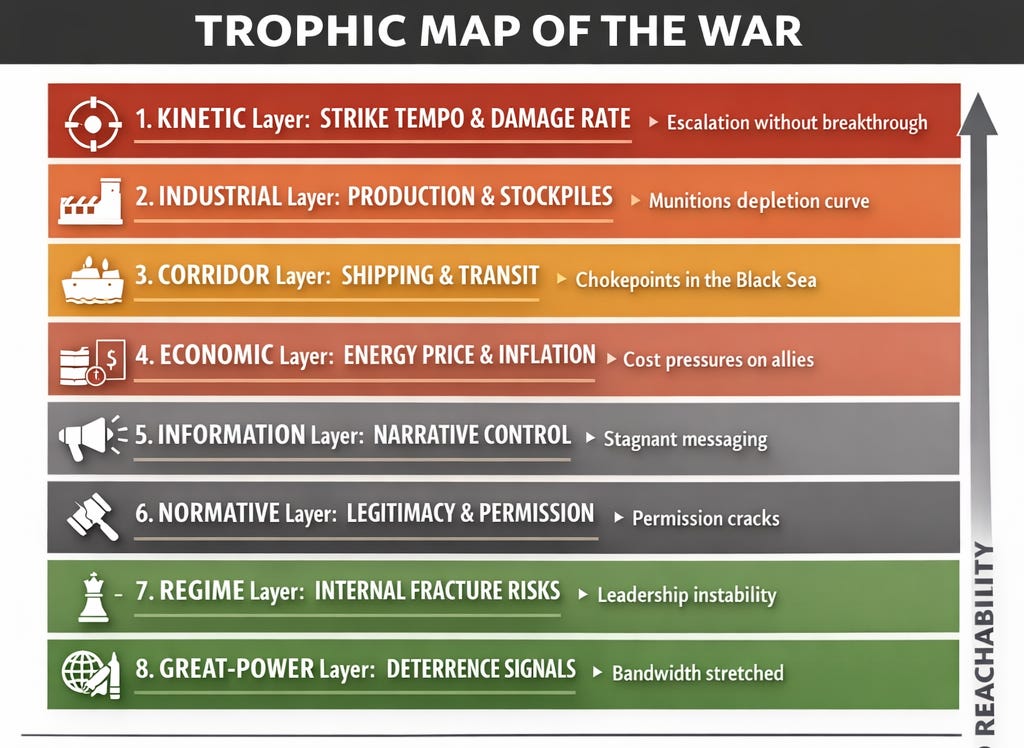
In GSNV terms, a “war” is never one thing. It is a stack of trophic layers—strata of action where each layer has its own necessities, thresholds, and currencies, and where higher layers are up-hierarchical integrations of lower ones. When people argue past each other (“we’re winning” vs “this is a disaster”), it’s usually because they are describing different trophic layers.
Below is a usable map of the war’s trophic layers, top to bottom, with what each layer “feeds on,” what it produces, and how it couples to the others.
1) Kinetic layer: force-on-force and physical survivability
Currency: destructive capacity, attrition, positional advantage, denial.
Necessities: targeting, air defense, strike tempo, concealment, dispersal.
Field effects: fear of vulnerability; “who can touch whom” changes behavior instantly.
Contact tests: launch rate, interception rate, sortie rate, kill chain speed, damage repair time.
GSNV point: kinetic dominance can be real and still not be decisive if it fails to re-open reachability corridors at higher layers.
2) Industrial-depth layer: replenishment, manufacturing tempo, supply chains
Currency: stockpile depth, production rate, component resilience, time-to-replace.
Necessities: interceptors, precision munitions, spares, maintenance, trained crews.
Periodicity: production ramps are slow cycles; war tempo is fast—mismatch is destiny.
Contact tests: burn rates vs replenishment curves; bottleneck components; lead times.
GSNV point: modern war is often decided by the second derivative: not what you have today, but whether your replacement function stays inside the tempo the theater demands.
3) Corridor layer: traversability of critical routes (shipping, airspace, pipelines)
Currency: safe passage, predictable transit, viable insurance, escort capacity.
Necessities: credible protection and credible risk underwriting.
Field effects: this is where “risk = uncertainty subtracted” becomes literal—fear fields can close corridors even when physical damage is low.
Contact tests: tanker counts, insurance premiums, rerouting behavior, port congestion.
GSNV point: “Hormuz” is not only geography; it’s a field threshold (underwriting + confidence). Re-opening it is a different kind of operation than destroying launchers.
4) Economic layer: prices, inflation, distributional pain, fiscal stress
Currency: energy price, inflation expectations, real wages, credit conditions.
Necessities: stabilizing supply expectations; managing second-order inflation.
Structural couplings: corridor disruptions → energy prices → domestic legitimacy → alliance cohesion.
Contact tests: oil benchmarks, inflation prints, subsidy moves, currency stress signals.
GSNV point: economic dynamics are not “consequences later.” They are real-time causal forces that reshape what political actions remain reachable.
5) Information layer: sense-making, narrative dominance, epistemic coherence
Currency: credibility, interpretive control, agenda setting, attention capture.
Necessities: coherent story, trusted messengers, low contradiction, visible competence.
Field effects: “truth” competes with salience; coherence often beats accuracy under stress.
Contact tests: divergence between official claims and observable reality; coalition messaging alignment; rumor propagation; media trust trajectories.
GSNV point: this layer doesn’t just “spin” the war—it selects behavior by shifting thresholds of permission and panic.
6) Normative layer: legitimacy, permission, moral thresholds, “who can do what”
Currency: permission to act (domestic + allied + global), not just capability.
Necessities: justificatory architecture that stays coherent under casualties, shortages, images, and time.
Field effects: legitimacy is a force multiplier; illegitimacy is a constraint generator.
Contact tests: coalition fracture signals, domestic dissent, elite defections, “red line” shifts, legal posture.
GSNV point (your punchline theme): if the normative field is treated as “owner policy” rather than as a living, multi-party evaluative field, strategy collapses into operations. You can win the target set and lose the corridor.
7) Regime topology layer: internal cohesion vs fracture (succession basins)
Currency: control of coercive apparatus, elite cohesion, defections, transition pathways.
Necessities: credible successor structure; avoidance of fragmentation attractors.
Structural couplings: decapitation/pressure → fissures → either transition corridor opens or civil-war basin deepens.
Contact tests: security apparatus behavior, factional splits, local disorder, emergent “transitional authority” signals.
GSNV point: “endgame” is not a plan; it’s a basin landscape. Actions reshape which basins become reachable and stable.
8) Great-power signaling layer: deterrence, bandwidth perception, preemption incentives
Currency: perceived initiative, perceived depletion, perceived restraint/unrestraint.
Necessities: credible depth across theaters; avoiding “window” illusions that invite opportunism.
Field effects: opponents don’t just react to what you do; they react to what it says about your future options.
Contact tests: posture shifts in other theaters, diplomatic quiet/activation, force movement patterns, industrial announcements.
GSNV point: unintended consequences are often just unmodeled couplings at this layer—especially when depth and normative permission are misread.
9) Metatheoretic layer: the war as a contest over the “rules of the world”
Currency: what becomes normal; which doctrines become default; which institutions regain authority.
Necessities: an ordering story that can be adopted widely enough to stabilize behavior.
Periodicity: slow cultural shifts + fast technological change create chronic mismatch.
Contact tests: alliance architecture changes; doctrine changes; new institutions (reinsurance schemes, coordination compacts, AI governance regimes).
GSNV point: wars often end by creating new trophic necessities (new “musts”) that outlast the battle.
The GSNV synthesis: where trophic lift and trophic drift happen
Trophic drift (danger): when actions increase unreachability—e.g., fragmentation attractors deepen, insurance fear remains high, coalition permission collapses. Drift is how “winning” becomes losing without a single dramatic defeat.
Trophic lift (opportunity): when the system generates new stable structures that didn’t exist before—new corridor governance, new industrial depth compacts, new legitimacy frameworks, new coordination institutions.
If you want one “CEO-level” line that captures the trophic stack:
The war will be decided not by who dominates the sky, but by whether the campaign produces trophic lift at the corridor, legitimacy, and transition layers—before drift locks the system into fragmentation and chronic risk.
MUST WATCH TO UNDERSTAND
https://youtu.be/_Ux13UEqIYo?si=BqyVeZB6szGX_fKY